Commission Models
Part of Affiliate commission structures and margins
Percentage commissions versus fixed acquisition fees
Compare percentage affiliate commissions with fixed acquisition fees using order values, a crossover point and contribution guardrails.
Pay a percentage when the publisher payment should move with eligible sale value. Consider a fixed acquisition fee when the approved outcome can support the same payment across the orders it covers. Compare both against your order mix and required contribution: which costs less changes with basket value.
Find the crossover point
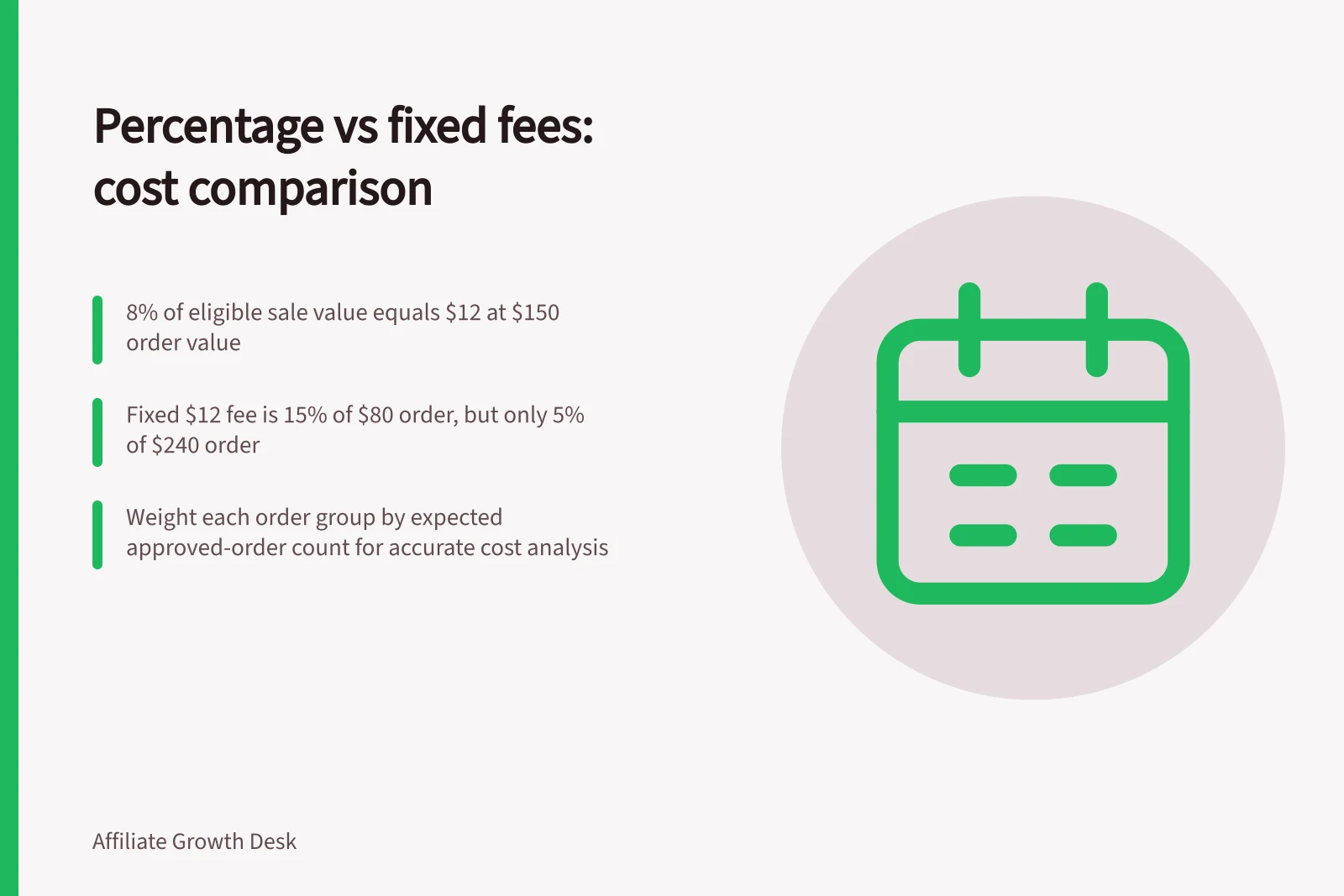
Suppose the proposed terms pay either 8% of eligible sale value or $12 for each approved acquisition. At $80, the percentage pays $6.40; at $240, it pays $19.20. The payments are equal at $150 because $12 divided by 0.08 is $150. These are hypothetical amounts, not market rates.
The $12 fee is equivalent to 15% of an $80 order but 5% of a $240 order. Small eligible orders therefore need a close margin check under a fixed fee. A percentage rises with its defined payout base, including when a larger basket contains items with little contribution.
Define the base before comparing the options. “8% of the order” and “8% of eligible items after discount” can produce different payments. For a fixed fee, say whether one approved order, one customer’s first purchase or another event earns it, and whether later orders can earn another fee.
Compare the order mix
Group approved orders, or a defensible forecast, by eligible value. Separate groups where discounts, product costs or customer status materially change contribution. Calculate the publisher payment under each option and the contribution left after that payment and other channel costs.
| Question | Percentage | Fixed fee |
|---|---|---|
| Does payment rise with the payout base? | Yes | No, for each qualifying event |
| Which orders warrant a close margin check? | Large eligible values with weak contribution | Small orders and inexpensive first purchases |
| What must be defined? | Eligible value, discounts and item treatment | Qualifying acquisition and payment frequency |
Do not choose from average order value alone. Programs with the same average can have different numbers of small, discounted or unusually large orders. Weight each group by its expected approved-order count. Include the proposed network or software charges and any separate placement payment under the actual commercial terms.
Choose a guardrail
A percentage can apply only to eligible items or use separate product rates where the platform and integration support them. A fixed fee can be limited to a defined first purchase or qualifying order. Tell publishers which outcomes qualify before they promote the offer.
Awin documents fixed and percentage payments for sales. impact.com documents percentage and fixed payouts either per order or per item. In the proposed account setup, test a mixed basket to confirm which items and order value the payout applies to.
State how full and partial refunds affect commission and when an acquisition becomes approved. Compare the two structures using expected approved outcomes, then choose the one that protects the required contribution across the orders the offer will cover.
Pros and Cons of Percentage vs Fixed Fees
- Percentage Commission – ProsAligns payout with higher-value sales; rewards publishers for driving larger baskets.
- Percentage Commission – ConsHigher cost on large orders; may not suit low-margin or discounted items.
- Fixed Acquisition Fee – ProsPredictable cost per approved acquisition; better for small or high-discounted orders.
- Fixed Acquisition Fee – ConsMay underpay on high-value sales; risk of overpaying if applied to multiple orders.