Programme Setup
Choosing products that can support an affiliate commission
Screen products for affiliate promotion using order contribution, discounts, fulfilment costs, availability and verifiable product facts.
Choose products by what remains after an eligible sale, not by selling price alone. A candidate needs enough room for fulfilment, discounts, publisher payment and other order costs, and must meet the business’s contribution target.
Use the contribution target established in the separate contribution calculation as the screen’s pass-or-fail threshold. This article applies that target to product orders; it does not set it.
A product also needs an offer a publisher can describe accurately and a customer can buy. Check order economics, availability and whether the offer information can be verified before including a line.
Screen the range
Start with products that have clear specifications, dependable landing pages and reasonably reliable availability. Record variants and exclusions.
Before adding a line, check that its destination shows the product and that the product can be bought. Record when you checked, then recheck when availability or offer details change and before a promotion.
A high-margin product that is often unavailable wastes a publisher’s work; a popular product with little room after discount may generate sales without supporting commission. Keep a line only when its order economics, availability and offer information all pass the screen.
Consider the basket as well as each product. If accessories commonly sell with a main item, decide which lines earn commission.
Check whether the payment is based on eligible items, the discounted order value or another amount stated in the terms. Also check that publisher commission costs fit within the overall marketing budget.
A single catalogue-wide rate may give poor results across products with different costs and return patterns.
Product Eligibility: High Margin vs. High Demand
- High-Margin Product (Unreliable Availability)
- Wastes publisher effort; may not generate commission despite sales
- High-Demand Product (Low Post-Discount Margin)
- Generates sales but may not support commission after costs
- Ideal Product (Stable Availability + Sufficient Margin)
- Supports commission, promotes reliably, and aligns with marketing goals
Build an order-level decision sheet
For each candidate range, record the following using a consistent GST basis. Use the same basis when comparing the lines.
| Input | Question to answer |
|---|---|
| Eligible revenue | Which items, discounts and shipping charges affect the amount used for commission? |
| Product and fulfilment costs | What does supplying the order cost? |
| Other order costs | What payment, service and expected return costs apply? |
| Publisher and programme costs | What commission and platform charges apply? |
| Contribution target | What must remain after those costs? |
Start with revenue after discounts, then subtract the applicable costs and proposed publisher payment. Do not subtract a discount twice if the starting revenue already reflects it.
Apply the calculation to a normal order, a discounted basket and the effect of a cancellation or return. A scenario passes only when the result meets the contribution target; if it falls short, exclude the line or narrow its eligibility.
This is an order-screening method, not a substitute for a business-wide profit and loss statement. A product-level pass also does not override the overall marketing budget for commission costs.
If a product misses the target, consider excluding it, narrowing eligibility or changing the offer. Recheck the calculation when prices, costs or promotions change.
Key Financial Inputs for Commission Screening
- Eligible Revenue Basis
- Post-discount order value
- GST Treatment
- Consistent GST-inclusive or GST-exclusive basis used
- Contribution Target
- Minimum profit required after all costs
- Publisher Commission Cost
- Within overall marketing budget (ATO-compliant)
Check whether publishers can promote it accurately
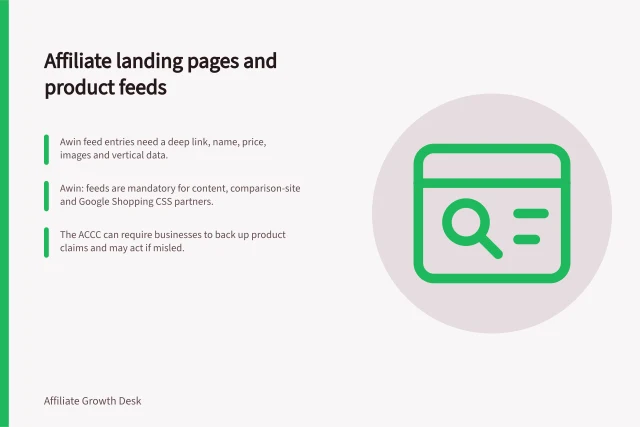
Give publishers current prices, product facts, material limitations, delivery information and a route for corrections. The ACCC says it can require businesses to back up claims they make about their products or services.
The ACCC’s “False or misleading claims” guidance says it can require businesses to back up claims about their products or services. The ACCC accepts reports about possible misleading or false claims and may investigate and take compliance or enforcement action.
Finish with a short launch list. For each included product, record the intended customer, source of product facts, current destination, commission basis and owner of future changes.