Incrementality
Comparing new-customer rates across affiliate types
Calculate comparable new-customer rates across affiliate activities, show unknown status and avoid mistaking customer mix for lift.
Apply the same definition of a new customer, the same eligible-order denominator and a comparable period to every affiliate type. A higher rate describes the mix of credited orders and does not prove that a type created more customers.
Define the customer and order
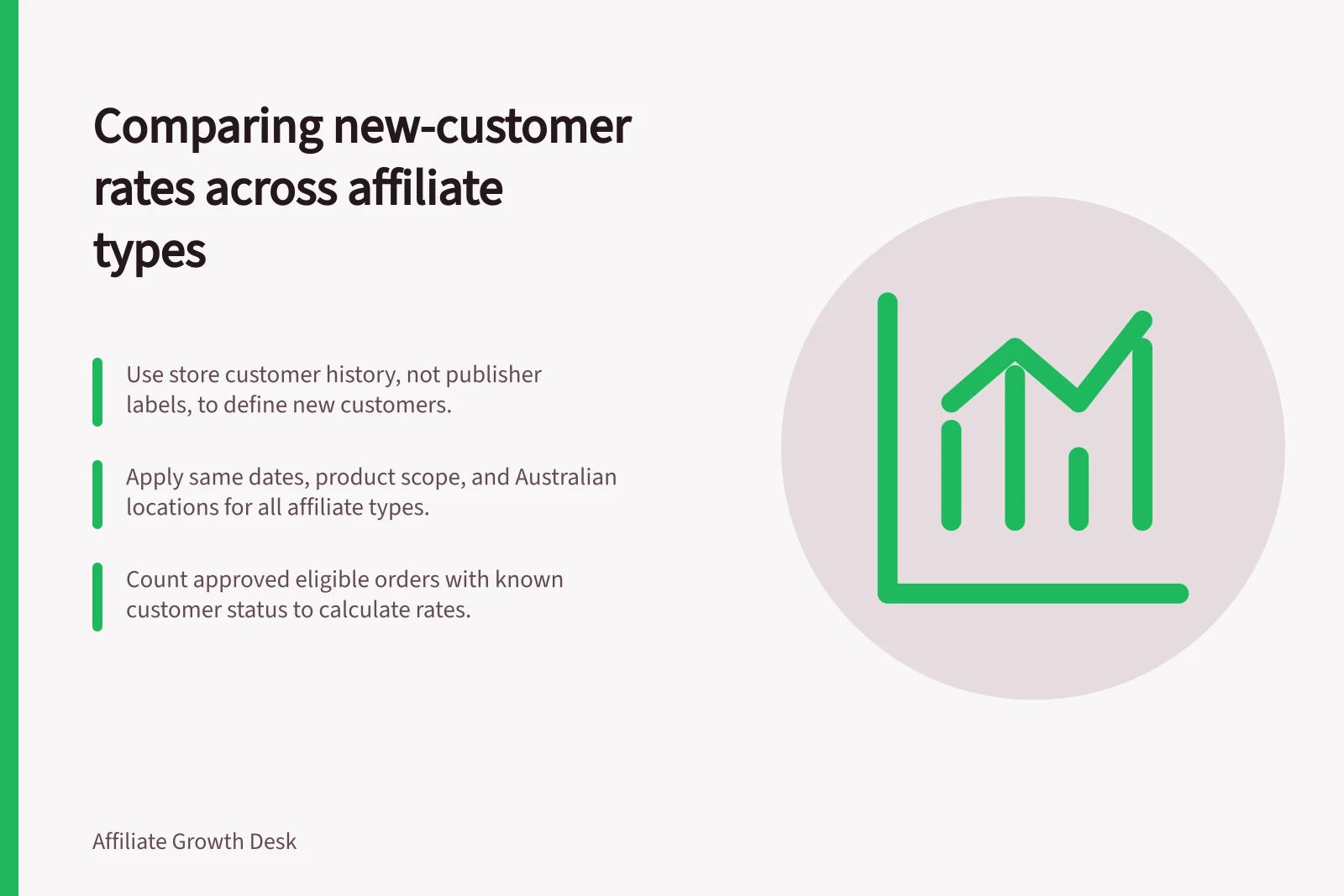
Use the store's customer history rather than a publisher label. One possible rule is no earlier approved purchase linked to the store's chosen identity key at the order date. Decide how guest checkouts, merged accounts, cancelled first orders and unrecognised customers are handled. Keep unknown status separate from new and returning.
If the question concerns payable sales, use approved eligible orders. Decide whether the measure counts orders or distinct customers; do not switch between them while comparing types. Apply the same refund cut-off so one group does not benefit from having more orders still awaiting review.
For an order-based comparison, calculate approved orders classified as new ÷ approved orders with known customer status for each type. Show the count and share with unknown status beside that rate. A group with many unknowns can appear strong because difficult-to-classify orders were excluded from its denominator.
Form comparable groups
Awin groups partners into five main promotional types: Content, Display, Email, Search and Other. These are platform labels, not mutually exclusive analytical groups. If you compare content guides, voucher placements, cashback and search activity, define those groups yourself and state how mixed-method partners and orders are assigned. Do not count one order twice in a total across groups.
Use the same dates, product scope and serviceable Australian locations. Show approved-order counts as well as rates. A small group's percentage can move sharply with a few orders. If one type promotes different products or runs during a major sale, split the view or describe that difference.
Check / Why it matters
- Known-status share
- Uneven missing data can distort rates.
- Products and offers
- Different propositions can attract different buyers.
- Approval basis
- Pending returns can change the denominator.
- Placement and credit rule
- A late credited touch may differ from product discovery.
Use the rate to choose the next question
A high rate may justify investigating a publisher's audience or testing its placement. A low rate may still accompany useful repeat-purchase contribution. Review contribution and, where feasible, a suitable holdout before claiming additional acquisition.
Awin's customer-acquisition reporting requires the advertiser to supply a conversion parameter with NEW or RETURNING. The platform reports the value supplied; the business must define and validate customer status. If unknowns have no valid platform value, retain them in the store analysis rather than assigning a status merely to complete the report.
Keep the definition, counts, missing-status share and limits beside any comparison used to consider a different offer, test or commission objective.