Incrementality
Part of Coupon and cashback affiliates
Assessing whether a coupon partner adds new customers
A coupon partner's dashboard usually shows credited orders.
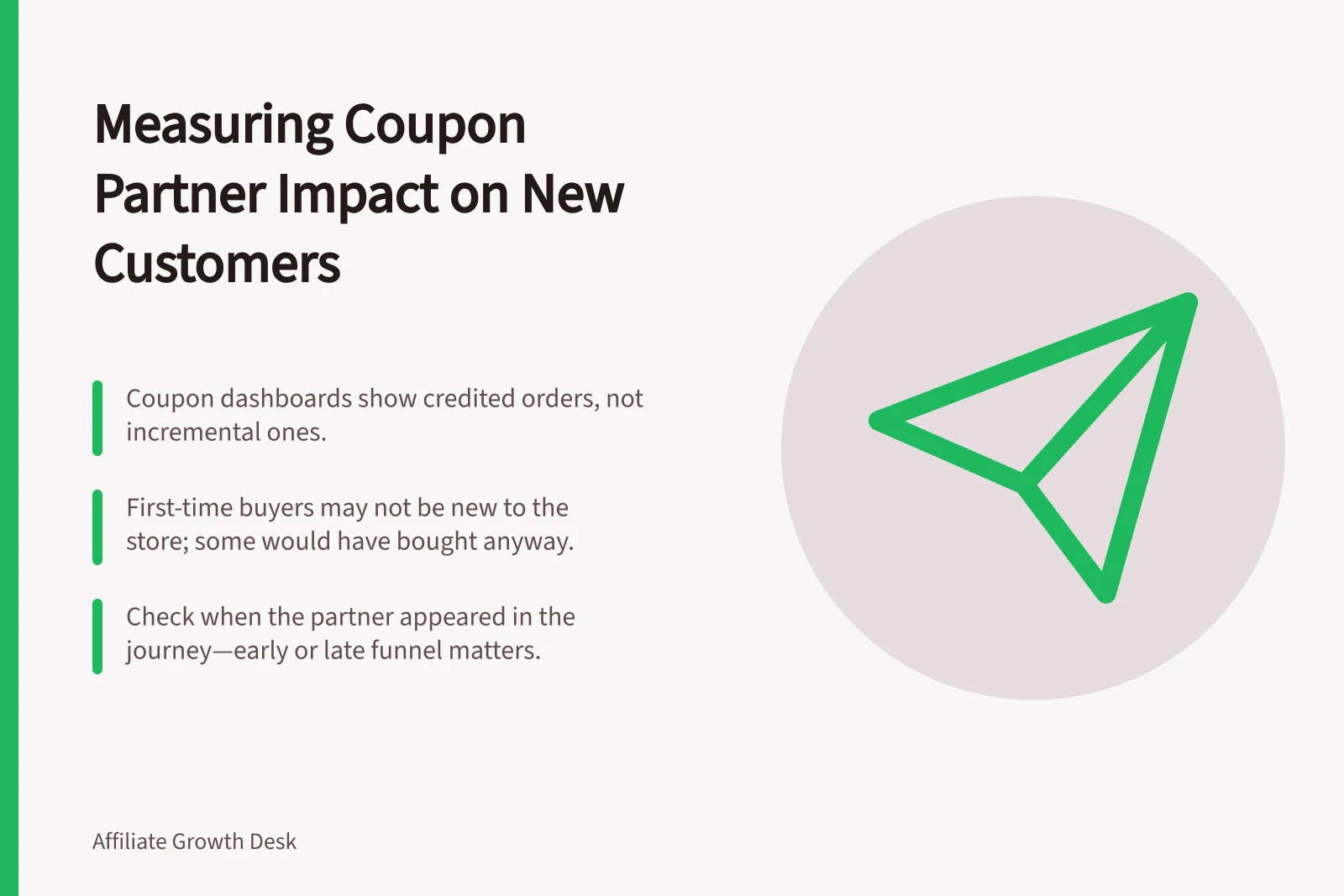
A coupon partner’s dashboard usually shows credited orders. It does not show how many would have happened without the partner.
Separate new-to-store customers from returning customers, and check how the store classifies each group. A first-time buyer is not automatically an incremental buyer; some would have purchased anyway.
Ask when the partner appeared in the observed journey. A shopper who discovers a product through an editorial placement differs from one who searches for a code after reaching checkout, and lower-funnel coupon sites can intercept existing demand.
Compare matched orders with the store’s first-visit source where available. That can help describe the journey, but it does not establish what would have happened without the partner; cross-device and consent data may also be missing.
A controlled holdout is stronger when feasible. Compare a test group exposed to the partner with a control group that is not, measuring the same new-customer outcome in both groups.
Calculate the new-customer purchase rate consistently for each group; the test rate minus the control rate is the observed lift. Use that difference to estimate additional new-customer orders rather than treating every code-credited order as incremental.
If a controlled holdout is not feasible, compare matched orders with a period or audience where the partner was not active. Account for seasonality and other promotions as far as possible, and treat the result as directional because this comparison does not isolate the partner as clearly.
Incremental ROAS (iROAS) expresses incremental revenue relative to ad spend: incremental revenue divided by ad spend, multiplied by 100 when reported as a percentage. It is more informative than total credited revenue for judging sales beyond the baseline.
For a generic calculation, subtract the $16,000 estimated to have happened anyway from $20,000 in attributed revenue to get $4,000 in incremental revenue. Against $2,000 in spend, iROAS is 200%.
Treat iROAS as one view, not a complete verdict on a coupon partner. Affiliate costs are incurred when conversions happen, and coupon sites may intercept demand that already existed.
Calculate net contribution from incremental orders, not all credited sales. A practical expression is incremental orders multiplied by product margin per order before deductions, less discounts, partner commission and return costs.
Check the credit rule before interpreting promo-code totals. impact.com’s Tracking Promo Codes can assign credit to or away from a partner depending on the click path and setup, while credit groups take precedence when both are active.
A promo code can be assigned to only one partner or media source; purchases by other partners using that code are invalid conversions. After a partner contract expires, its assigned code remains active, and sales attributed to that code and partner appear in the Invalid Conversions Report.
Use estimated lift and incremental contribution to decide whether to expand, renegotiate or narrow the offer. Keep uncertainty visible: a directional contribution estimate is more useful than claiming every tracked order was created by the partner.
Credited Orders vs Incremental Orders: What’s the Difference?
- Credited Orders (Dashboard Count)
- All orders attributed to a coupon code
- Incremental Orders (True New Customers)
- Orders that would not have occurred without the partner
Pros and Cons of Using Coupon Partners for Customer Acquisition
- ProsCaptures high-intent shoppers; can drive short-term spikes in sales; effective for new product launches
- ConsRisk of intercepting existing demand; may attract price-sensitive customers; affiliate costs only incurred on conversion
Best Practices for Evaluating Coupon Partner Performance
- Verify credit rules in your tracking platformEnsure promo codes are assigned to one partner only; check for invalid conversions post-contract expiry
- Account for seasonality and concurrent promotionsUse historical data or matched control periods to isolate partner impact
- Calculate net contribution, not gross credited revenueSubtract partner commission, discounts, and return costs from incremental orders
- Communicate uncertainty in resultsTreat directional estimates as guidance, not definitive proof of incrementality