Commission Models
Part of International affiliate expansion from Australia
Setting cross-border commission economics
Set an overseas affiliate commission by comparing destination-specific order costs, payout rules and currency exposure with the retained contribution required.
Set an overseas affiliate commission from what an eligible order in that destination can spare. Start with the product and destination, then define the payout base, currency and approval conditions. An Australian commission rate is only a starting comparison: overseas delivery, destination charges, payment costs and returns can change what is available.
Define the covered order
State which products, destinations and approved sales the rate covers. A practical payout base is eligible merchandise revenue after discounts, excluding separately stated delivery and destination VAT collected at checkout. Remove cancelled or refunded item value, and adjust partial returns.
If you use another base, define it explicitly, including whether it includes tax or shipping. Keep the commission calculation and affordability worksheet on the same base.
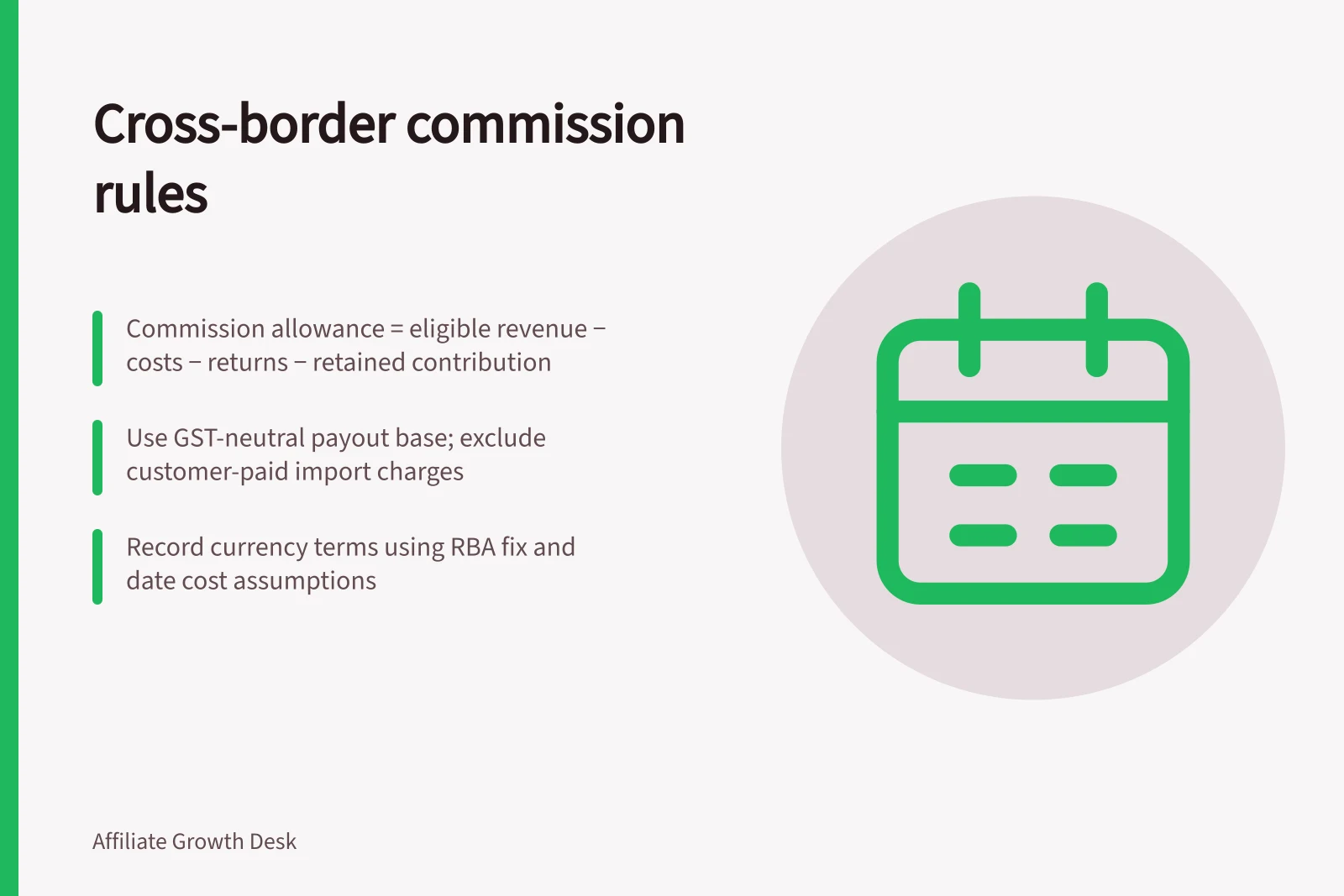
Use a consistent GST basis in the worksheet, and have finance confirm the treatment of the actual supply. Currency does not determine tax treatment.
Separate charges paid by the customer from those funded by the business. A customer-paid import charge may affect appeal without appearing as a merchant order cost. A merchant-funded charge belongs in the affordability calculation. Confirm the arrangement for the actual route before promising a landed price.
For qualifying EU-bound physical goods, the Import One-Stop Shop (IOSS) covers consignments valued at €150 or less. It lets a business collect VAT at checkout using the buyer country's rate; keep that VAT out of eligible revenue available for commission.
From 1 July 2026, the EU's €150 customs-duty exemption is removed, with a flat €3 duty per item for low-value parcels under an interim system. This duty also applies to IOSS-registered sellers, so include it as a cost when the business funds it.
Find the destination's commission allowance
For each destination and approved order group, calculate: Commission allowance = realised eligible revenue − product cost − merchant-funded fulfilment and destination costs − payment and currency costs − expected return and service costs − variable programme costs − required retained contribution. Use recorded results where available, label estimates and count each loss once.
If revenue is already net of a refund, do not subtract the refunded sale again; separately include any return-handling cost the business bears. Keep customer-funded charges out of merchant costs, but account for them if the business pays them.
Build separate destination rows for Spain and Sweden if both are served. IOSS applies the buyer country's VAT rate, so identical products can generate different VAT amounts depending on destination.
Compare the overseas worksheet with the same product's Australian worksheet line by line. Identify which costs, customer charges and currency exposures change for this destination.
For a positive payout base, the maximum affordable rate is the positive commission allowance divided by that base. Set the proposed rate at or below that ceiling; if the allowance is zero or negative, a positive commission cannot meet the stated retained-contribution target under those assumptions.
Commission Allowance Calculation: Australia vs. EU (Post-1 July 2026)
- $7Expected Return & Service Costs
- $2Variable Programme Costs
- $10Required Retained Contribution
- $3Commission Allowance (Net Available)
- 3%Maximum Affordable Commission Rate
Check the proposed rule
Apply the rate to a small order, a discounted order, a heavier parcel, a mixed basket and a partial return. For EU orders, test consignments at €150 and above it: IOSS covers goods valued at €150 or less, so do not carry that VAT assumption above the threshold.
If a group fails, consider a narrower product or destination rule where the platform and integration can actually supply and use the required data. Do not promise a conditional rate on a field the commission calculation does not receive.
Approve a destination rate only after the cost assumptions, who funds destination charges, payout base and currency basis are recorded and checked. Date the worksheet at approval and review it when price, freight, merchant-funded duties, return experience or currency terms change.
Cost any separate placement fee alongside commissions over the period it supports. Keep that fixed commitment visible even when individual orders appear affordable.
State the currency terms
Record the sale currency, payout-base currency, commission currency and conversion point. For Australian approval, calculate all inputs in AUD using a dated assumption for converting any EUR or US-dollar amounts, and state who bears relevant conversion charges. Reconcile obligations using the contract and transaction records.
For US-dollar rates, the Reserve Bank of Australia (RBA) has published the WM/Reuters Australian Dollar Fix at 4.00 pm Sydney since 1 July 2008, sourced from Thomson Reuters and rounded to four decimals. Most other currency rates are calculated by crossing the US-dollar rate with observed mid-points; RBA rates indicate market value and may differ from dealer rates.
If customer prices or merchant costs move with exchange rates, repeat the worksheet under plausible adverse movements chosen by the business. Keep review triggers for price, freight, merchant-funded duties, return experience and currency terms.
The resulting rate schedule should show eligible orders, payout base, currency, exclusions, approval rule and dated cost assumptions. Payment execution and bank settlement belong to the separate payment process.
Key Cross-Border Commission Factors (Australia to EU)
- RBA WM/Reuters AUD Fix Time
- 4.00 pm Sydney
- GST Treatment Basis
- Consistent with supply location, not currency
- Currency Conversion Source
- Thomson Reuters (via RBA)