Affiliate Operations
Part of Affiliate programme reporting
Building an affiliate channel profitability report
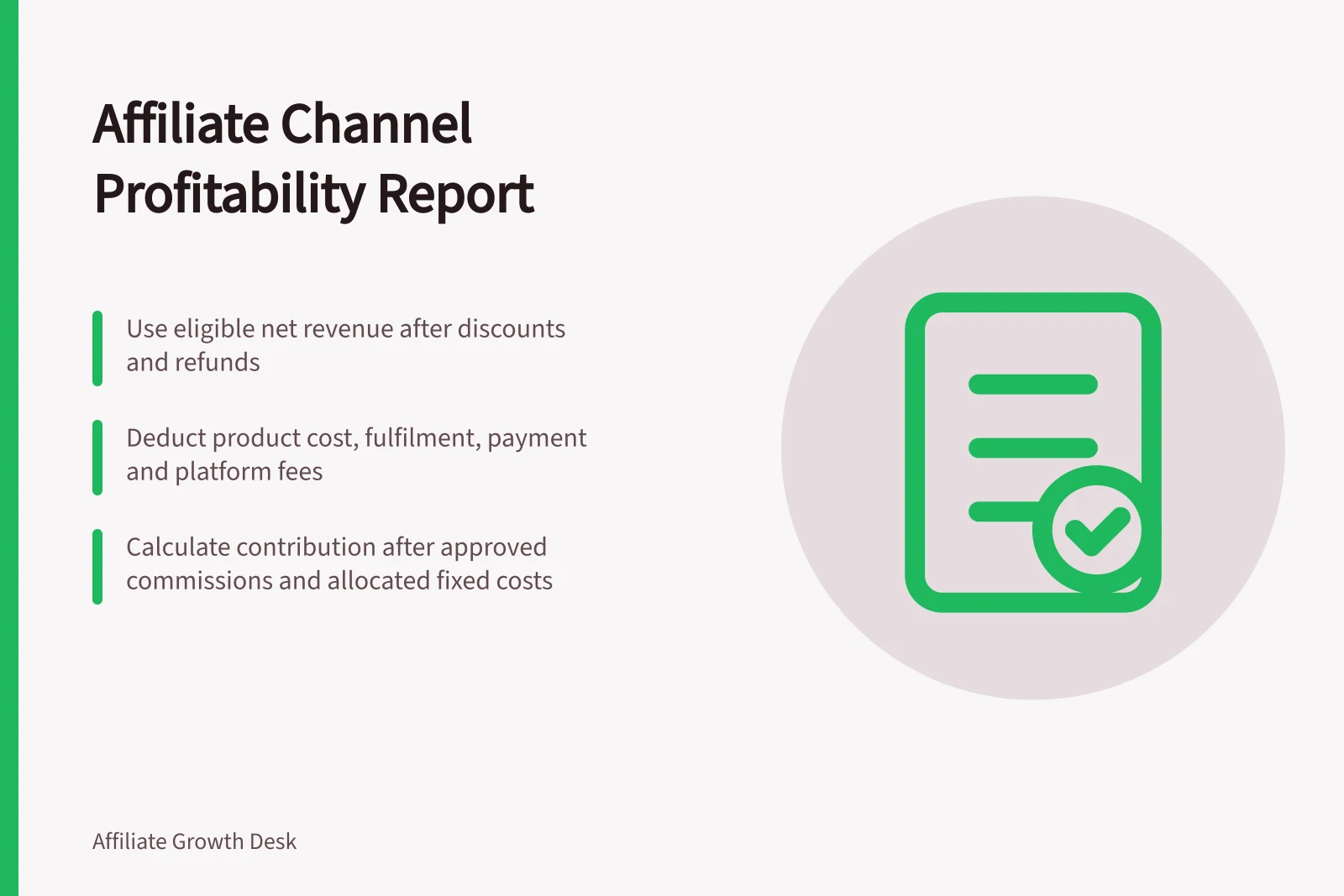
Use an order cohort, approved commissions and internal costs to report contribution from affiliate-attributed orders without overstating profit.
Build the report from eligible orders and their tied costs. Use a stated reporting cut-off for later refunds and commission decisions.
Show what remains after supplying the orders, paying publishers and running the channel. Label the result contribution from attributed orders unless the business has also established that those orders were additional. It is not the whole company’s profit.
Choose one order cohort
Select orders placed in a defined period and keep each order’s later approval, refund and cost changes attached to that cohort. A second view can show commissions approved during the month for invoice reconciliation. Do not mix purchase-date revenue with approval-date commission without explaining the timing difference.
Join affiliate transactions to store orders using the order reference, retaining the platform transaction ID and publisher ID. Investigate unmatched and duplicate records before summing. Awin Classic’s Transactions report includes transaction-level sale amount, commission, date and commission status, and can show a network-fee column, although that fee may not be visible under special invoicing terms. impact.com’s Performance by Partner report breaks tracking data down by partner, including actions, clicks and revenue.
Neither provider report replaces a complete internal cost ledger. Check the fields available in the actual account.
Lay out the calculation
Use a consistent currency and GST basis. Start from eligible revenue after discounts and confirmed refunds. If refunded value has already reduced revenue, do not subtract it again as a cost. Add the cost of handling a return only if that is a separate cost the business bore.
| Line | What to include |
|---|---|
| Eligible net revenue | Covered items after discounts and recorded refunds, on the chosen basis |
| Less product or service cost | The cost of supplying those items |
| Less order costs | Fulfilment, payment and other variable service costs |
| Less publisher costs | Approved commission, placement fees or other agreed payments |
| Less platform costs | Applicable transaction fees and an explicitly allocated share of fixed charges |
| Result | Contribution from attributed orders after the defined costs |
For a hypothetical period, suppose eligible net revenue is A$10,000. Product cost is A$5,000, fulfilment A$800, payment cost A$200 and return-handling cost A$300. Approved commission is A$1,000, platform transaction fees A$200 and allocated fixed programme cost A$300.
The result is A$2,200. These are invented worksheet inputs to show the arithmetic, not an observed programme result. Refunded sales are already reflected in the A$10,000, so they are not deducted again.
Treat open items and shared costs visibly
Pending commission needs its own line or an estimate labelled as such; it is not approved expenditure yet. Show the effect of material unresolved refunds as a sensitivity or exception. Where a network invoice applies, compare its approved commissions and fees with the order-level records. A difference may reflect a different invoice period or later validation, so record the period used on each side.
Allocate fixed software, management or creative costs using a stated rule, such as a period charge assigned to this channel. If staff work supports several channels, show the allocation basis. A figure excluding those costs may still be useful, but its label must say so. Do not present a platform dashboard’s revenue-to-cost ratio as full profitability when relevant product and fulfilment costs are absent.
Break the report down only where costs can follow the same boundary: by product group, publisher type or partner. A placement fee benefiting several periods should be assigned across those periods under a documented rule. Keep any uncertain cost in an “unallocated or unknown” line instead of making a partner appear more profitable through missing data.
The final page should show the calculation, open exceptions and the next decision. A positive contribution on credited orders supports an affordability discussion. Whether the affiliate activity produced additional sales is a separate measurement question.