Click Tracking
Part of Affiliate fraud and attribution disputes
Investigating duplicate commission claims
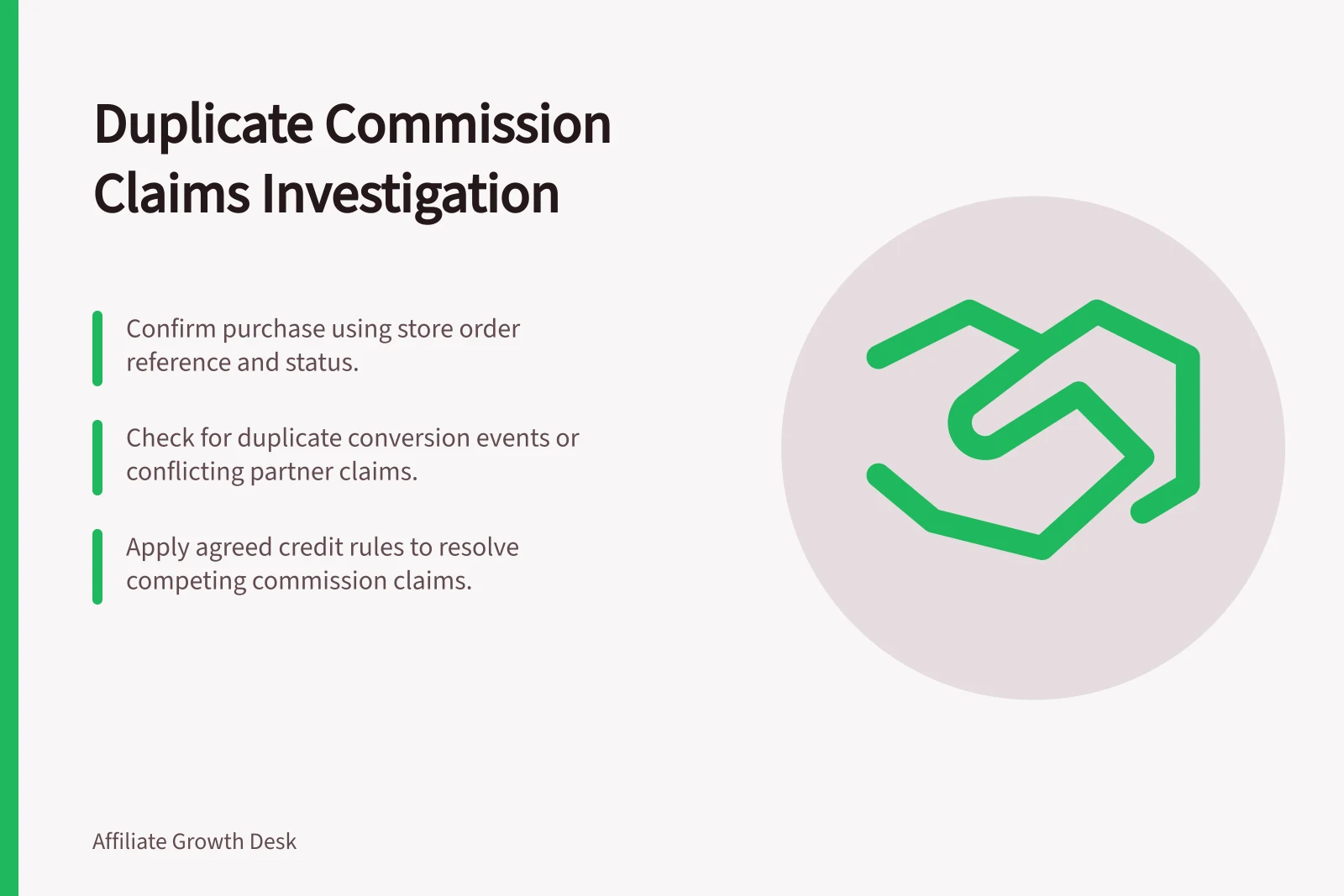
Separate duplicate tracking events from competing publisher claims, reconcile the order and apply the agreed credit rule.
When several commission records appear to refer to one order, confirm the purchase first. Then determine whether a conversion was recorded more than once or different partners are contesting credit. Removing an extra event addresses duplicate payment; deciding who earns commission requires the agreed credit rule.
Reconcile the order
Start with the store's order reference and current status. Collect the related network transactions and publisher claims. Record each transaction ID, publisher ID, event type, amount, currency, time and commission status.
Use the order reference as the routine matching key where possible, rather than customer names or email addresses. Investigate near matches as well as exact matches: an amended or replacement order may have a different reference.
Confirm with the commerce record whether two references mean one purchase, two purchases or an exchange. Similar amounts and times alone do not justify merging records.
Explain why several records exist
For one confirmed purchase, compare the conversion payloads and integration routes. Check whether the purchase event fired twice, an old tag remained active during migration, or separate networks recorded the sale without a shared credit rule.
Awin says its automatic one-partner handling assumes affiliate activity is not also running on another network. The guidance on Awin's e-commerce plugins notes that if you were using ShareASale plugins, the update window finished on 6 October 2025 and those plugins are now in maintenance-only mode: tracking continues, but updates and advanced features such as order auto-void and product feeds are no longer available. Neither point diagnoses an individual case.
If different partners have valid, distinct referrals, reconstruct the eligible clicks and apply the terms in force for that order. Check the referral window, credit policy and any relevant voucher or placement exception. A late click wins only if the agreed rule gives it credit. Preserve the event history even when only one commission is payable.
Cross-Network Tracking: Awin vs. ShareASale Plugins
- Awin e-commerce pluginsAutomatic one-partner handling; no support for dual network tracking.
- ShareASale pluginsNo longer updated; maintenance-only mode since 6 October 2025; limited features including order auto-void and product feeds.
Resolve each claim
Correct a duplicate event through the platform's supported process while retaining the valid order record. For competing credit, document why one claim qualifies and the other does not.
Where click history is incomplete, ask for relevant placement details and decide within the applicable platform and contractual timetable on the evidence available.
For example, one store order might appear twice in one network and once in another. Removing the extra record within the first network still leaves a cross-network credit decision. The number of records alone does not establish fraud.
Tell each affected publisher the case or order reference, applicable rule and outcome, subject to customer-data limits. If the terms never explained cross-network claims, escalate the current case for a documented decision and clarify the policy prospectively.
Key Facts on Duplicate Commission Handling
- Primary matching key
- Order reference (not customer name or email)
- ShareASale plugin update deadline
- 6 October 2025
- Awin's default credit rule
- One-partner handling assumes no concurrent network activity