Click Tracking
Part of Affiliate fraud and attribution disputes
Distinguishing tracking errors from deliberate abuse
Trace missing or duplicate affiliate events, test the tracking route and require conduct evidence before alleging deliberate abuse.
A missing sale or unexpected attribution path does not prove that an affiliate acted dishonestly. Trace the tracking route, then look for evidence that publisher conduct breached a programme term. A technical fault and prohibited activity can coexist, so test each explanation separately.
Establish what was recorded
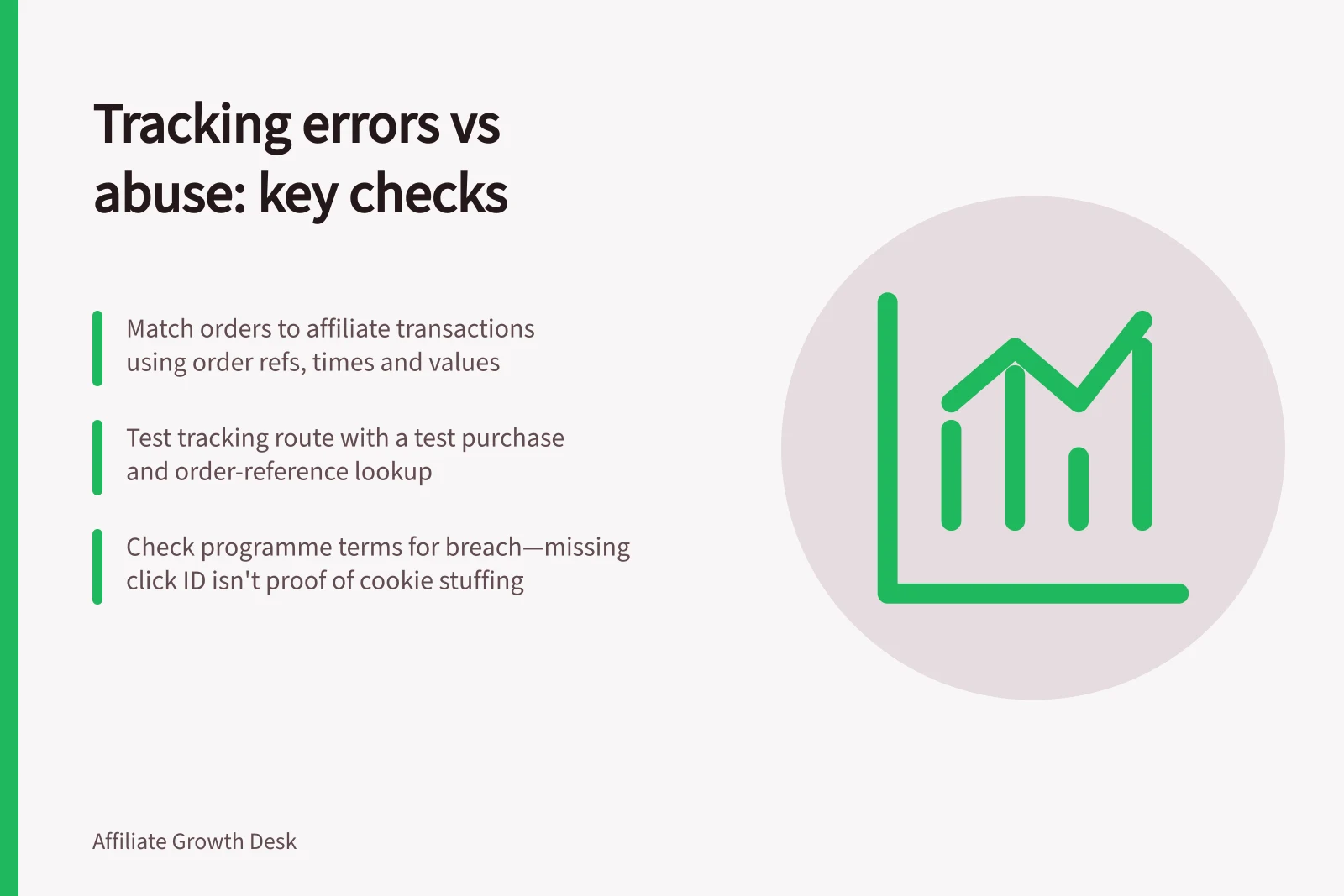
Match a sample of store orders to affiliate transactions using order references, event times, values and status. Note missing, duplicated and unexpectedly credited orders, and preserve the original export or event record alongside any correction. Record whether discrepancies began after a checkout release, tag change or network migration.
Awin Classic’s transaction-query guidance lists possible reasons for an untracked sale: tracking downtime, third-party-cookie blocking, or credit going to another partner. A transaction query is a partner’s request to check a sale or commission; the query itself does not establish publisher abuse.
Awin Classic’s tracking diagnosis procedure uses a test publisher link, a purchase and an order-reference lookup. A reproducible fault on the affected route supports a tracking explanation; a test result does not, by itself, establish what happened on a disputed customer order.
Common Causes of Untracked Sales (Awin Classic)
- Tracking downtime
- Yes – reported in transaction queries
- Third-party cookie blocking
- Yes – common with modern browsers
- Credit assigned to another partner
- Yes – possible if multiple referrals exist
Test plausible technical causes
Follow a referral through landing page, basket, checkout and confirmation. Check whether the identifiers required by the chosen integration are retained, whether the conversion event fires and whether the order reference stays consistent. Test the browser or checkout version implicated by the discrepancy, then compare the test order in the store and affiliate platform.
For Awin Classic, the Tracking Diagnosis Tool can create a test transaction and provide a unique test publisher link. Complete a purchase through that link, then check the transaction using its order reference. This helps establish whether the tested route records the transaction.
Overlapping integrations can create duplicate records. Where a legacy plugin setup runs alongside a newer integration, treat duplicates as a prompt to inspect configuration rather than as an explanation for every duplicate.
A missing click ID is also inconclusive. impact.com says it can attribute some conversions using other user identifiers, including in cross-device scenarios, when the relevant data has been supplied. A credited conversion does not mean every earlier interaction appears in a reporting view, so record what the integration and account can show.
Assess conduct against a stated rule
Cookie stuffing is a named example of attribution fraud. To assess whether publisher conduct supports an abuse finding, identify the relevant programme term that was active when the order occurred, then look for recorded conduct that conflicts with it. A short click-to-sale interval, high click volume or contested order is a clue, not evidence of intent by itself.
Ask for the relevant page, creative or campaign details, then compare them with the recorded source and timing. The available records may show a discrepancy or a mismatch with the declared placement; if they do not show what the publisher did, the evidence does not support calling the conduct deliberate. A transaction query or missing sale alone is not evidence of cookie stuffing.
A reproducible tracking fault calls for repairing the integration and assessing affected commissions. Evidence of a breach of an agreed publisher rule calls for preserving the placement and event records, seeking the publisher’s response and deciding under the terms. If the evidence is incomplete or conflicting, state what is missing and document the decision within the applicable timetable.
Before changing a commission, check its validation or locking date. Describe a demonstrated tracking correction accurately, and reserve an abuse finding for conduct supported by the evidence.
Tracking Error Indicators vs. Evidence of Abuse
- Possible Tracking Error
- Missing click ID, duplicated transactions after plugin overlap, untracked sale post-tag change
- Evidence of Deliberate Abuse
- Cookie stuffing, inconsistent attribution paths, repeated high-volume clicks without conversion