Click Tracking
Part of Affiliate landing pages and product feeds
Keeping tracking intact during landing-page redirects
Map affiliate page redirects, preserve the intended destination and required referral information, then check a controlled order against its affiliate record.
When an affiliate landing page moves, check two outcomes: the old affiliate link reaches the intended new page, and an eligible order still appears under the expected referral. A redirect reaching any page proves only that a destination was reached.
Map the page move
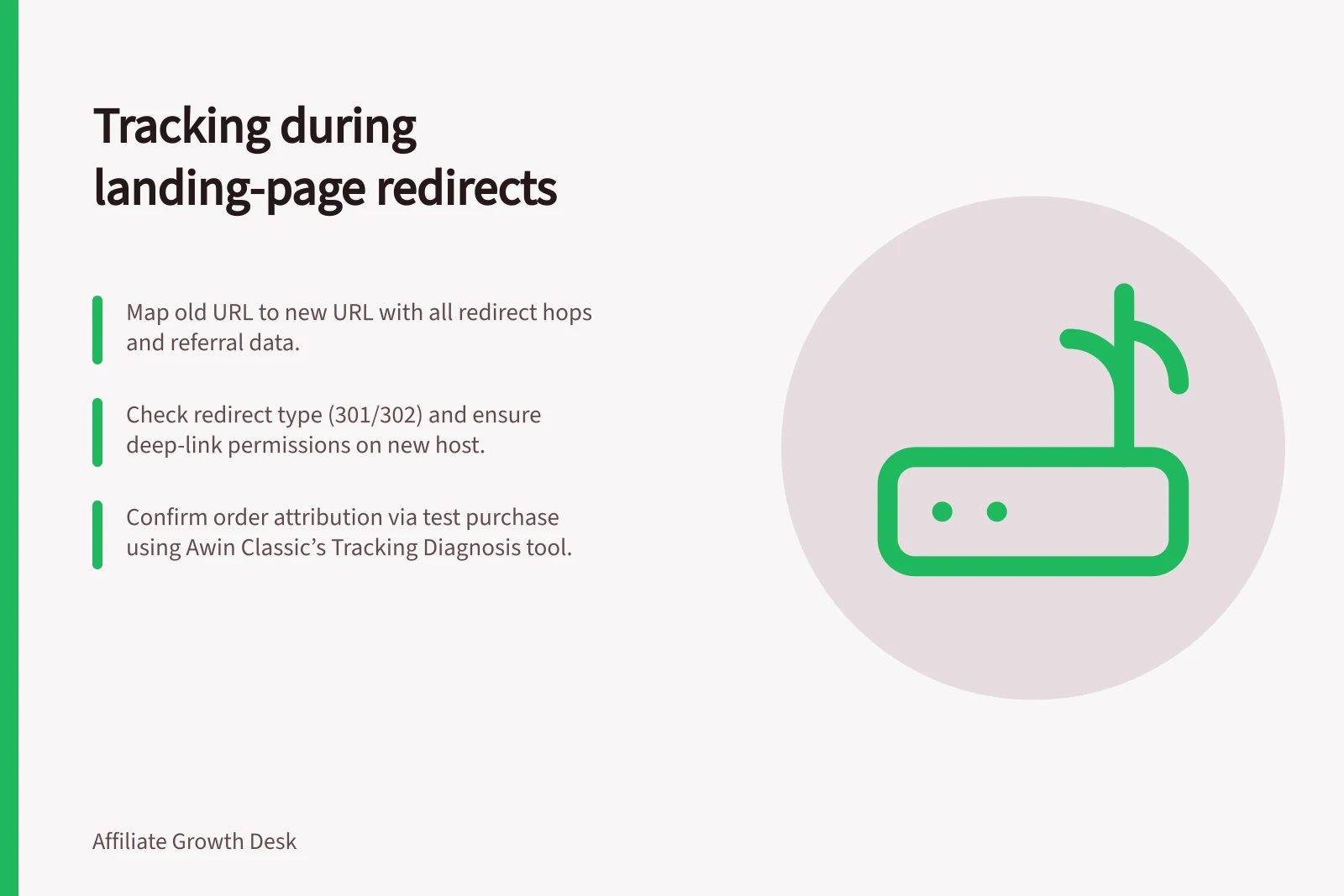
Record the old URL, the intended new URL, the affected product or category, and every redirect between them. Start with a publisher link that still points to the old page, then note each response, hostname, path and query string before inspecting the final page.
A product-specific link should reach the corresponding live item, or an honest unavailable-product page where that applies. A homepage may break the publisher’s promise even if tracking continues.
Identify which referral information the configured integration needs at landing, and how it retains that information for conversion reporting. Preserve the required values through the site redirect.
An affiliate click ID, a publisher ID and an analytics campaign tag do not necessarily share a purpose. Not every incoming query parameter should be forwarded without review.
Awin documents click appends, which let an advertiser send variables or other identifiers via the query string, and a standard source parameter that returns a value of aw when the click was referred through an Awin URL. Other programmes and integration routes can differ, so check the actual implementation and account settings.
Key Parameters in Affiliate Tracking via Query Strings
- Click Appends (Awin)
- Enable sending variables or identifiers via query string
- Source Parameter
- Returns `aw` when click comes from an Awin URL
- Publisher ID
- Identifies the referring affiliate or publisher
- Campaign Tag
- Tracks performance of specific marketing campaigns
Check the redirect rule and final host
Keep an explicit old-to-new mapping. Inspect the response and final URL for loops, unnecessary hops, a lost variant selection or a missing required referral value.
Choose a permanent or temporary redirect to fit the page move; Google Search Central treats 301 and 308 as permanent signals, and 302 and 307 as temporary ones, for indexing. The status code does not establish whether affiliate attribution works.
If the move changes hostnames, check deep-link permissions. On Awin Classic, an enabled accepted-domain control sends a deep link for an unaccepted domain to the programme’s default landing page. A successful-looking page load can therefore still be the wrong destination.
Redirect Status Codes and Their Impact on SEO and Tracking
- 301Permanent Redirect — Signals permanent move; recommended for long-term changes
- 308Permanent Redirect — Same as 301; preserves request method (e.g. POST)
- 302Temporary Redirect — Indicates short-term change; not ideal for permanent moves
- 307Temporary Redirect — Preserves request method but signals temporary status
Confirm the changed route with an order check
Use the affiliate platform’s supported test method. Begin from the old publisher or test link, record the expected publisher and final page, and complete the relevant purchase route with a distinct store order reference.
Compare that reference and credited publisher with the affiliate transaction. Awin Classic’s Tracking Diagnosis tool documents a test publisher link, test purchase and order-reference lookup. Follow the safeguards of the actual programme so the check is handled as a test.
If the final page is wrong, fix the redirect or domain permission. If the page is right but the transaction is missing, hand the recorded redirect chain and order reference to the checkout-tracking investigation.
If a different publisher receives credit, inspect the programme’s recorded interactions and credit rule before attributing the cause to the page move. One successful order covers only the route used for that check.
Keep the mapping and check record with the page-change ticket. Recheck important old links and feed-generated destinations after product URL changes, storefront migrations and campaign-page expiry; publishers may continue using an older trackable link.